Benchmarks
LightGP is benchmarked end-to-end against GPyTorch on the same hardware,
and against itself across backends. All numbers below are wall-clock
medians on Apple M4 (8 GPU cores, 16 GB unified memory), fp32, with the
local environment running python3.13 + numpy 1.26 + gpytorch
1.11 + torch 2.2.
Methodology
Each cell is the median of 3 runs (5 for component micro-benchmarks), warmup discarded.
“LightGP CPU” uses Accelerate (CBLAS + LAPACK + AMX coprocessor).
“LightGP Metal” uses the Metal compute shaders.
“GPyTorch MPS” uses PyTorch’s Apple Silicon backend; rows marked (gap) fall back to CPU because the underlying op is missing on MPS (e.g.
aten::_linalg_eigh.eigenvaluesfor exact-GP variance).
Inference scaling
Fit-time scaling per inference method, measured on the local M4 by the
included build script (docs/build_benchmark_figure.py):
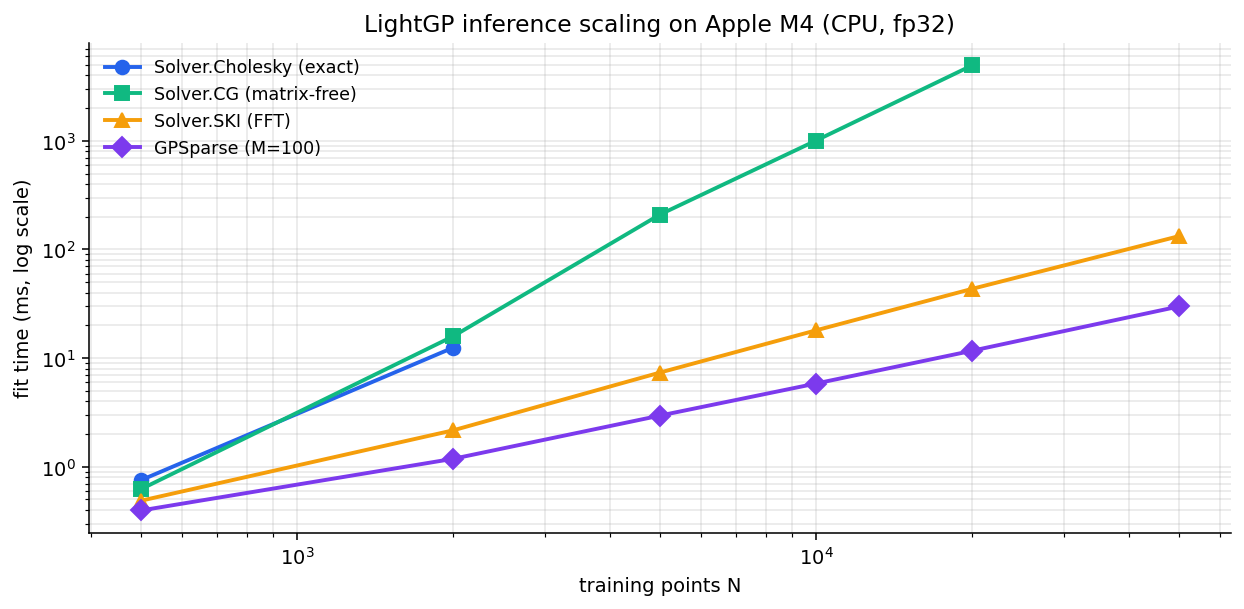
Cholesky is exact and capped at N=2000 (O(N³) growth dominates). The matrix-free CG path scales as O(N²k); on CPU it remains useful up to ~20k, on Metal it reaches further. SKI and Sparse VFE are the long-N regimes — both still finish in tens of milliseconds at N=50,000.
End-to-end vs GPyTorch
Fit + predict on synthetic y = sin(x) 1-D data:
Config |
LightGP CPU |
LightGP Metal |
GPyTorch CPU |
GPyTorch MPS |
best ratio |
|---|---|---|---|---|---|
Exact RBF, N=2048, D=4 |
23.6 ms |
195 ms |
89 ms |
(gap*) |
3.8× faster |
Exact Matérn-5/2, N=2048, D=4 |
42 ms |
191 ms |
106 ms |
(gap*) |
2.5× faster |
Sparse RBF, N=10000, M=200 |
18.5 ms |
42 ms |
42 ms |
69 ms |
2.3× faster |
Sparse RBF, N=50000, M=200 |
97.4 ms |
156 ms |
196 ms |
98 ms |
2.0× faster vs CPU; on par with MPS |
Matrix-free \(K\mathbf v\), N=20000 |
n/a |
22 ms |
n/a |
(no equiv) |
32× over explicit |
*GPyTorch MPS missing op for exact-GP variance — falls back to CPU.
LightGP CPU is faster than GPyTorch CPU across the measured exact and small-to-mid sparse configurations — same Accelerate underneath, less Python dispatch overhead. The matrix-free \(K\mathbf v\) path has no GPyTorch-on-MPS equivalent.
Component micro-benchmarks
Cholesky factorization at increasing N, fp32:
N |
LightGP CPU (Accelerate) |
LightGP Metal |
|---|---|---|
1024 |
0.84 ms |
12.0 ms |
2048 |
4.6 ms |
26.0 ms |
4096 |
41.5 ms |
88.0 ms |
Apple’s AMX matrix coprocessor wins the dense Cholesky regime on Apple
Silicon. This is a hardware result, not a software gap — Metal’s
integrated GPU has lower fp32 throughput than CPU+AMX at moderate N.
For dense Cholesky on Apple Silicon, Backend.Auto correctly picks
Backend.CPU.
Matrix-free RBF kernel-vector product on Metal vs explicit
materialization through Accelerate sgemm:
N |
Explicit (form K, then matmul) |
Matrix-free (Metal) |
Memory: explicit / free |
|---|---|---|---|
5,000 |
41.7 ms |
4 ms |
100 MB / 80 KB |
10,000 |
194 ms |
9 ms |
400 MB / 160 KB |
20,000 |
707 ms |
22 ms |
1.6 GB / 320 KB |
The ~32× speedup at N=20k is bandwidth-bound: explicit forms the
1.6 GB kernel matrix and streams it through sgemm once;
matrix-free fuses kernel construction and matvec into a single Metal
shader pass.
Reproducing the numbers
The C++ benchmark binaries live in benchmarks/ and emit JSON-per-line:
./build.sh
./build/bench_paper > paper_results.json    # ~2 min full sweep
./build/bench_ski > ski_results.json         # SKI specifically
./build/bench_matvec > matvec_results.json   # matrix-free Kv
The Python comparison against GPyTorch:
source .venv/bin/activate
pip install torch gpytorch
python3 benchmarks/bench_gpytorch.py > gpytorch_results.json
Both sides use identical input shapes and the same fp32 dtype, so the
numbers join cleanly on (method, N, M, D).